Non-native professionals train connected speech in American English by actively retraining their speech system, not by memorizing linking rules. Reading about linking, assimilation, elision, and intrusion builds awareness, but fluent connected speech only becomes automatic through guided articulation practice, sentence-level drilling, and paragraph-level speaking under expert correction. MyAccentWay’s Interactive Accent Training, led by Prof. Alex, Ph.D. Accent Coach / Linguist, moves students from isolated American sound articulation through phonetic exercises, sentence practice, and presentation-style paragraph delivery so connected speech becomes a natural, confident part of professional communication.
How Do Non-Native Professionals Train Connected Speech in American English?
Non-native professionals train connected speech american english by physically retraining articulation patterns through guided practice, not by memorizing linking rules on a page. Knowing a rule and producing it under pressure are two different skills, and most advanced speakers have only built the first one.
What Is the Difference Between Understanding Connected Speech Rules and Actually Using Them Automatically?
Understanding a rule means you can explain it; producing it automatically means your speech organs do it without conscious thought. A professional might know that “want to” often becomes “wanna” in casual American speech, or that “did you” can blend toward “didja” [3]. That knowledge sits in the same mental folder as grammar rules, useful for recognition, useless for real-time speaking.
Automatic production requires something different: a retrained articulation system that links sounds the way American speakers do, without the speaker stopping to think about it. This is the same distinction that separates knowing vocabulary from speaking fluently, one is stored information, the other is a trained motor skill [4].
Why Do Professionals Know About Connected Speech but Still Struggle to Produce It Naturally?
Many non-native professionals already have strong vocabulary and grammar, sometimes stronger than native speakers in technical fields, yet they still sound clipped or word-by-word when they speak [2]. The reason is not intelligence or preparation. Their sound system was built around their native language’s rhythm and was never retrained for how American English physically links, reduces, and blends words in a stream of speech [5].
This gap shows up hardest in real conditions. A professional can drill linking exercises alone at home and sound reasonably smooth. Put that same person in a client call, a job interview, or a live meeting, and the gains often disappear. Attention shifts to content, what to say, how to answer, how to sound competent, and the untrained sound system reverts to old habits.
Closing that gap takes more than self-study or passive repetition. It requires interactive practice where a trained coach hears the breakdown in real time, corrects the specific articulation pattern causing it, and drills that correction into sentence- and paragraph-level speech until it holds up under pressure.
What Are the Main Sound Changes in Connected Speech American English Uses?
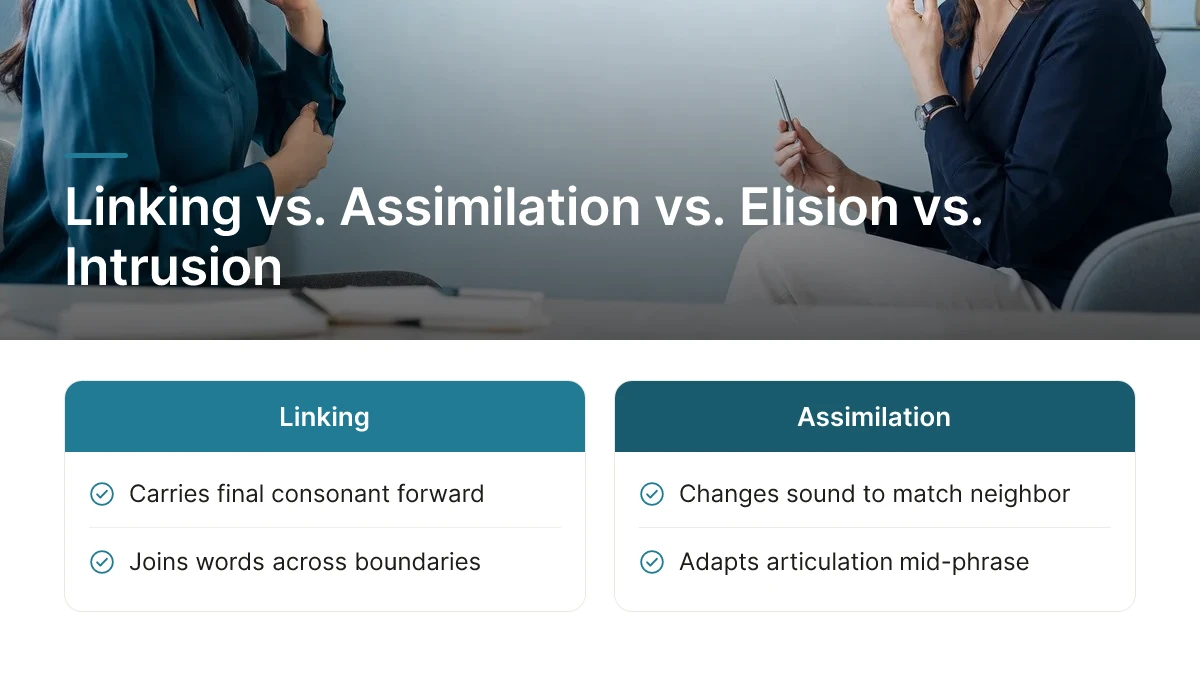
Connected speech American English relies on four mechanisms, linking, assimilation, elision, and intrusion, that change how words sound when spoken together in real sentences.
Native speakers apply these patterns automatically. Non-native professionals who learned English through written grammar and vocabulary often never trained their ear or speech organs to produce them, which is why fluent reading on paper doesn’t always translate to fluent-sounding speech in meetings or patient conversations.
How Do Linking, Assimilation, Elision, and Intrusion Work Differently?
Linking (catenation) carries a final consonant into the vowel that starts the next word. “Turn it off” doesn’t land as three separate words, the final “n” and “t” sounds slide into “it,” and the “t” of “it” slides into “off,” producing something closer to “tur-ni-toff.” Skipping this pattern makes speech sound clipped and overly deliberate, a common trait among professionals who over-enunciate to compensate for accent anxiety.
Assimilation happens when one sound shifts to match a neighboring sound. “Did you” commonly blends toward a “didj-oo” pattern because the “d” and “y” merge into a single sound [5]. This is not sloppy speech, it’s a documented, rule-governed feature of how English sounds interact in fast, natural speech [4].
Elision drops a sound entirely when consonant clusters pile up. “Next day” often loses its middle “t” sound, becoming closer to “nex day,” because English speakers simplify clusters that are awkward to produce quickly [5]. Formal training documents describe this as a rule-based simplification of consonant clusters, not a pronunciation shortcut reserved for careless talkers [5].
Intrusion inserts an extra sound between two vowels to smooth the transition. A “w” sound often appears between “go” and “on” (“go-w-on”), and an “r” sound frequently bridges “law and order” in American speech [3]. These intrusive sounds exist because English avoids placing two vowels back-to-back without a connecting glide.
What Mistakes Do Non-Native Professionals Make When Applying Connected Speech Rules?
Over-correction is the most common failure point. Some professionals drop so many sounds that colleagues lose track of word boundaries entirely, especially in technical vocabulary or names that need to stay distinct. Others apply casual reductions in contexts that call for clarity, a pharmacist confirming dosage or a manager reading numbers aloud in a meeting should slow linking down, not speed it up. The goal isn’t maximum blending; it’s matching the right pattern to the right professional context, which is exactly what structured, corrected practice trains.
Why Does Connected Speech Make American English Sound Fast and Hard to Understand?
American English feels fast because its rhythm compresses unstressed syllables into short bursts, not because speakers actually talk faster than in other languages.
English is a stress-timed language, which means the time between stressed syllables stays roughly even, regardless of how many unstressed words or syllables sit between them. To keep that timing, speakers compress function words like “to,” “for,” “and,” and “a”, squeezing them until they nearly disappear. This is the mechanical root of connected speech american english: rhythm forces reduction, and reduction is what non-native listeners perceive as speed. A sentence with five words and a sentence with nine words can take nearly the same time to say if the extra words are unstressed [5].
How Does Connected Speech Affect Listening Comprehension in Casual Conversation Versus Business Meetings?
Casual conversation pushes reduction to its limit, friends talking over coffee link, drop, and blend sounds with little regard for a listener’s processing time. Business meetings slow the pace and add clearer stress on key content words, but linking and reduction do not disappear. A phrase like “What do you think?” still collapses into something closer to “Whaddaya think?” in a client call, just delivered with more space around it.
For healthcare professionals and business specialists, this creates a specific problem: the classroom or textbook version of English rarely matches either register. A rushed hallway handoff between nurses and a formal case presentation to a physician group both rely on connected speech, just at different speeds and levels of formality [1]. Professionals who only trained on slow, careful audio struggle in both settings, because neither casual nor professional American speech is fully spelled out.
How Does American English Connected Speech Differ From British or Australian English?
Connected speech exists in every English variety, but the specific linking, reduction, and rhythm patterns are not identical across them. American English relies heavily on the flap T, turning words like “water” and “better” into sounds closer to a quick “d,” while British and Australian speech more often preserves a fuller T or uses a glottal stop instead [3]. Vowel reduction patterns and intonation contours also differ. A learner who studied primarily with British-produced material may find American speech oddly unfamiliar, even after years of English study, simply because the reduction rules were trained on the wrong variety.
Why Listening and Speaking Difficulties Reinforce Each Other
The comprehension gap and the production gap are the same problem viewed from two sides. A professional who cannot perceptually parse “gonna,” “wanna,” or a flapped T in fast speech almost never produces those reductions naturally either, the ear has to recognize the pattern before the mouth can reproduce it [4]. This is why MyAccentWay’s Interactive Accent Training pairs listening discrimination with active production practice from the start, rather than treating connected speech as a listening-only skill to absorb passively over time.
How Can You Practice Connected Speech Patterns Until They Become Automatic?
Automaticity comes from graduated practice, sentence drills first, then paragraph-length material, then real workplace scripts, combined with active feedback, not silent repetition.
What Is the Difference Between Practicing Connected Speech in Sentences Versus Full Paragraphs?
Isolated sentence drills teach the pattern, but they rarely transfer to real conversation because a single sentence does not demand the breath control, pacing, and thought-group planning that longer speech requires. A speaker can link “want to” into “wanna” perfectly in a drilled sentence and still revert to word-by-word pronunciation the moment a real meeting adds pressure, unfamiliar vocabulary, or a longer thought.
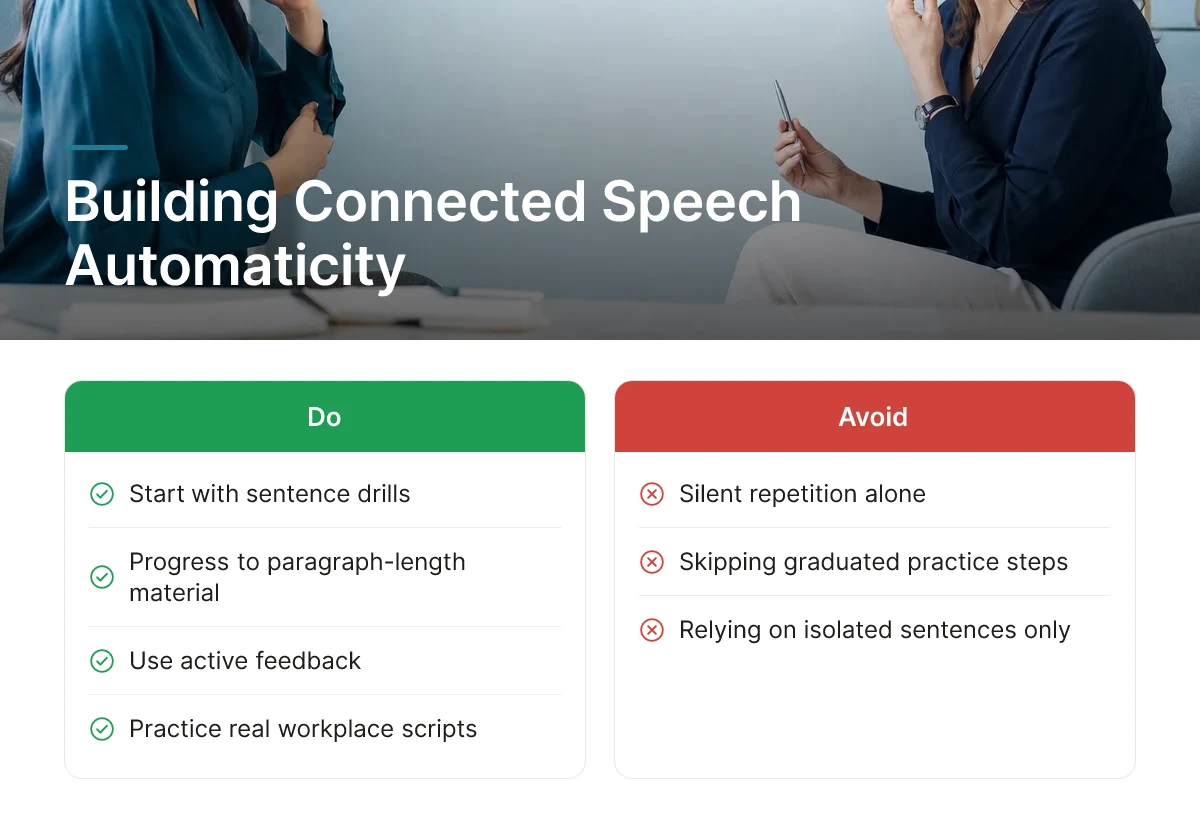
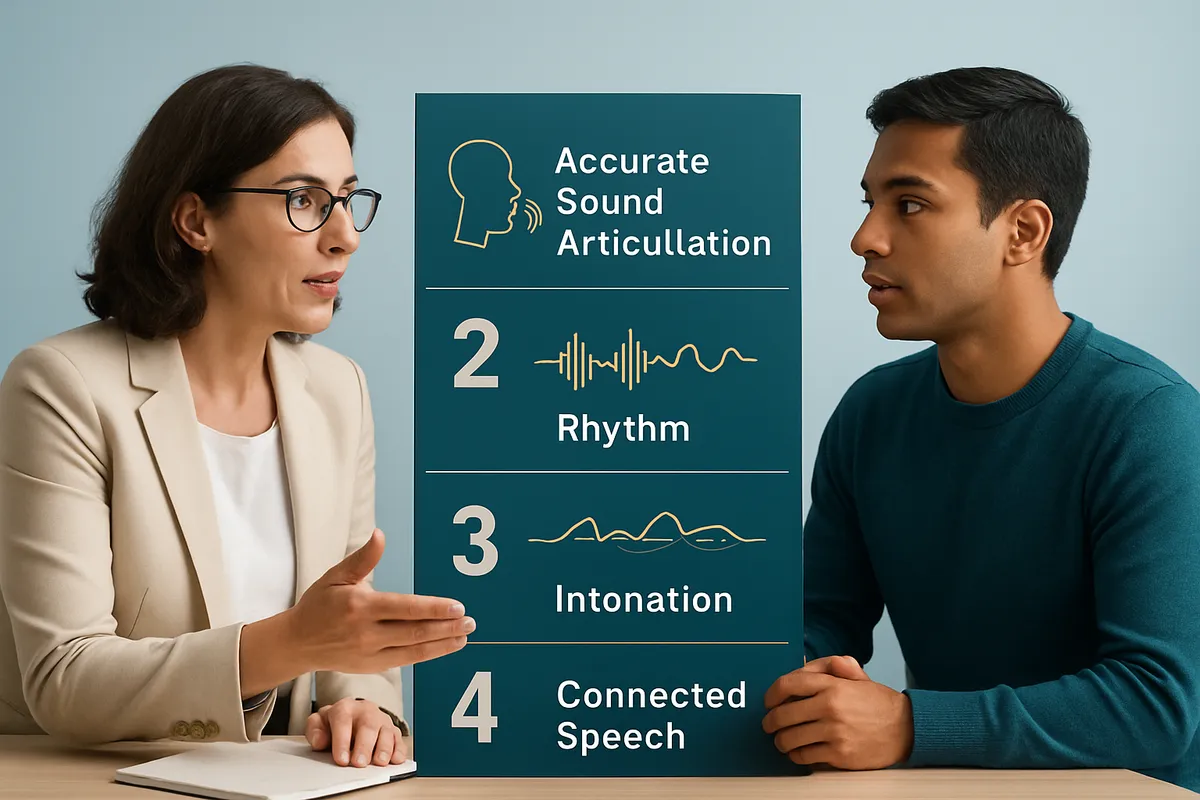
This is why MyAccentWay’s four-stage training path moves students from sound articulation into phonetic exercises, then sentence practice and intonation training, and finally paragraph practice with presentation-style delivery. Paragraph-length practice forces a student to sustain connected speech american english patterns across multiple clauses, pauses, and stress shifts, the same demands present in a client call or a conference presentation. Sentence-level accuracy without paragraph-level stamina rarely holds up under real professional pressure.
How Do You Know If You Are Over-Applying Connected Speech Rules?
The clearest signal is listener feedback: if colleagues repeatedly ask you to repeat key content words, names, numbers, technical terms, decisions, you are likely reducing words that need to stay clear. Connected speech rules apply naturally to function words like “to,” “and,” or “of,” not to the nouns and verbs carrying the message. A professional explaining a diagnosis, a budget figure, or a project deadline should keep those words crisp even while linking the surrounding function words smoothly.
Practicing inside real workplace material makes this easier to catch. Reading an actual meeting script, a set of presentation notes, or a rehearsed interview answer aloud reveals exactly where over-reduction creates confusion, because the content is meaningful rather than a generic drill sentence.
Building this skill also requires a feedback loop: hearing the target pattern, comparing it against your own recording, and adjusting in real time. Silent repetition without a comparison point tends to reinforce existing habits rather than correct them. In interactive 1-on-1 sessions with Prof. Alex, this comparison happens live, he identifies where reductions help fluency and where they undercut clarity, then guides the adjustment on the spot rather than leaving the student to guess.
How Does MyAccentWay’s Interactive Accent Training Build Connected Speech American English Skills?
MyAccentWay trains connected speech american English through four connected stages that move a student from isolated sound accuracy to natural, linked professional speech under Prof. Alex’s guidance.
Connected speech is not taught as a separate lesson at MyAccentWay. It develops as the natural result of a structured process that starts with sound-level precision and ends with paragraph-level delivery. Each stage builds the physical and cognitive control needed for the next.
What Is the Role of 2D Sound Motion Technology in Training Connected Speech?
Clean linking and natural reduction depend on precise articulation, and Prof. Alex uses 2D Sound Motion Technology to train that precision at the source. Interactive 2D Sound Motion Simulators guide students through the exact tongue, lip, jaw, and airflow movements behind each American sound, so students are not guessing at pronunciation but actively following a simulation-based movement pattern.
The Interactive 2D Sound Motion Simulator that trains the American unvoiced sound [t] shows this directly. Students who master the flap and stop variants of [t] through this simulator gain the articulation control that later lets phrases like “get up” or “not yet” link smoothly instead of sounding clipped or over-enunciated. Without this sound-level foundation, students often reduce or link words inconsistently, which can make speech harder to follow rather than more fluent.
How Does Prof. Alex Guide Students Through the Four Stages to Build Natural Connected Speech?
The first stage, American sound articulation training, uses the simulators described above to build accurate vowel and consonant production. The second stage, phonetic exercises, drills those sounds into sound combinations, reductions, and assimilations, the building blocks of connected speech american English patterns. The third stage, sentence practice and intonation training, applies linking and stress across full sentences so rhythm starts to sound natural rather than mechanical. The fourth stage, paragraph practice with presentation-style delivery, carries that fluency into real professional contexts: meetings, client calls, and public speaking.
Alongside these stages, Cognitive Accent Training helps students understand why their native-language rhythm resists American linking patterns in the first place. A student whose first language stresses every syllable evenly, for example, may unconsciously fight the reductions that make American English sound smooth. Building that awareness alongside correction is what makes the change durable rather than a temporary fix.
Results vary by student, but the pattern of improvement shows up consistently in MyAccentWay’s before-and-after results. Abishek’s pronunciation evaluation, Tian’s pronunciation evaluation, and Vlad’s pronunciation evaluation each document measurable gains in clarity and flow after structured interactive training.
Readers ready to work on this directly can book a 1-hour Interactive American Accent Training Session with Prof. Alex.
Frequently Asked Questions
Is connected speech the same as speaking fast?
No, connected speech is about linking and blending sounds, not speed. A speaker can talk slowly and still connect words naturally, or talk quickly and sound choppy if every word is pronounced in isolation. The goal at MyAccentWay is smooth linking and reduction, controlled at a pace the listener can follow, not rushed delivery.
Can advanced English speakers still have unnatural connected speech patterns?
Yes, strong vocabulary and grammar do not guarantee smooth connected speech. Many advanced professionals pronounce each word separately, which sounds correct but rhythmically foreign to American listeners. This is exactly the pattern Prof. Alex targets in sentence practice and intonation training, after sound articulation is stable.
Should I use connected speech in formal presentations and interviews?
Yes, appropriate connected speech supports clarity even in formal settings; it is not casual slang. Native speakers naturally link words like “want to” into a smoother flow during interviews, meetings, and presentations. The difference in formal contexts is pacing and thought-group control, not avoiding connected speech altogether. MyAccentWay’s paragraph practice stage trains this presentation-style delivery directly.
How long does it take to make connected speech feel automatic?
Most professionals notice change within weeks, though full automaticity depends on consistent, structured practice. Because connected speech depends on stable sound articulation first, students who skip that foundation often struggle longer. MyAccentWay’s four-stage path moves from sound training to phonetic drills to sentence and paragraph practice, which is why students typically see progress within an 8-12 week structured program.
Do I need to lose my accent to sound natural with connected speech?
No, the goal is clarity and natural rhythm, not erasing your accent or identity. Cognitive Accent Training at MyAccentWay focuses on retraining specific patterns that affect intelligibility while keeping your authentic voice. Clear connected speech and personal accent can coexist.
Conclusion
Connected speech is not a bonus skill layered on top of grammar and vocabulary, it is the third pattern that determines whether professional English sounds fluent or effortful. Fixing it requires stable American sound articulation first, then rhythm, then paragraph-level delivery, not isolated tips or repetition drills. Prof. Alex builds this through Interactive Accent Training and 2D Sound Motion Technology, moving students from sound formation to confident public speaking and workplace communication. Review the before-and-after results from real students, then book a 1-hour Interactive American Accent Training Session with Prof. Alex to identify exactly which stage is holding your spoken English back.
Sources & References
- English language guidelines for foreign-born professionals – Penn State Health News
- Do Accent Reduction Classes Work? | ALTA Language Services
- Linking and Connected Speech | San Diego Voice and Accent
- Connected Speech In English: What It Is And How To Learn It
- Introduction to Linking & Connected Speech
Recommended Articles
Explore more from our content library: