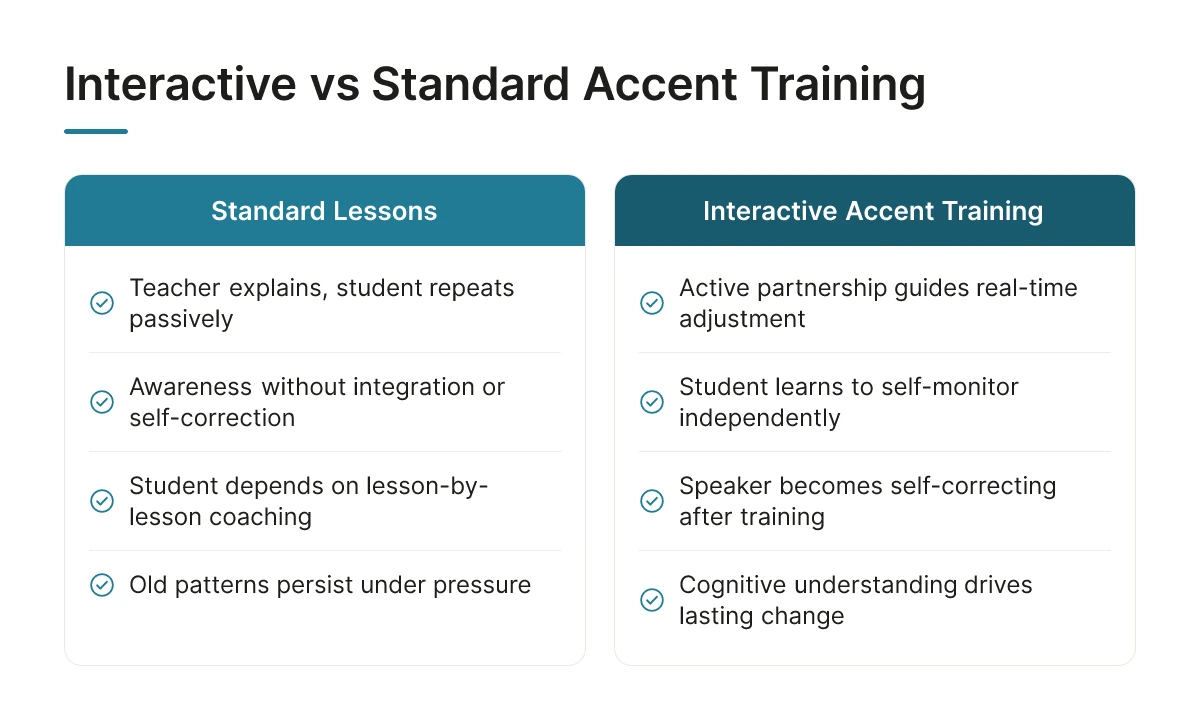
Interactive accent training differs from traditional accent training in one core way: the student actively drives the change instead of passively repeating after a coach. In interactive 1-on-1 training, Prof. Alex evaluates each student’s speech patterns in real time, uses guided tools like 2D Sound Motion Technology, and helps the student listen, compare, adjust, and rebuild American pronunciation with cognitive understanding, not just memorized repetition. This active, partnership-based process is why MyAccentWay students develop more stable, independent American speech patterns than repeat-after-me methods typically produce.

How Does Interactive Accent Training Differ From Traditional Repetition-Based Accent Training?
Traditional accent training builds awareness of mistakes; interactive accent training builds the ability to hear, adjust, and correct those mistakes in live, unscripted speech.
The traditional model follows a familiar sequence. A teacher explains how a sound is formed, the student repeats it a few times, the coach offers a correction, homework gets assigned, and the class moves on to the next sound or rule. This pattern can run for months without producing speech that holds up outside the lesson. The student hears the correction, nods, and moves on, but nothing in that sequence trains the student to catch the same error the next time it appears in a meeting, a phone call, or a live presentation.
Why Doesn’t Awareness of Pronunciation Mistakes Alone Create Stable Speech Change?
Knowing a mistake exists is not the same as being able to stop making it in real time. Repetition drills train short-term accuracy inside a controlled exercise, but they rarely train the self-monitoring skill needed to catch a dropped sound or flat intonation pattern while speaking spontaneously at work. Without a structured way to compare an intended American sound against the sound actually produced, most students revert to old speech habits the moment attention shifts from pronunciation to content, which is exactly what happens in a real conversation.
What Makes a Partnership-Based Approach More Effective Than Passive Listening and Repetition?
Prof. Alex, Ph.D. Accent Coach, Doctor of Education, and professional linguist at MyAccentWay, reverses the traditional roles. Instead of dictating a correction and moving on, Prof. Alex evaluates the student’s actual sound patterns, rhythm, and intonation as they happen, then guides the student through active listening, comparing, speaking, and adjusting inside the same session. The student is not a passive recipient of feedback, the student is trained to notice the gap between the target sound and their own production, and to close that gap themselves.
This partnership-based correction matters because it builds a skill that outlasts the coaching relationship. Students who learn to self-monitor rhythm, stress, and articulation during live practice carry that skill into meetings, interviews, and presentations long after formal sessions end. That is the practical difference between awareness and integration, and it is why MyAccentWay structures every session around active participation rather than passive repetition.
In this article we will use interactive accent training to describe this active, partnership-based process, not a fixed technique, but the working relationship between coach and student that produces lasting change.
What Role Does Cognitive Understanding Play in Building Authentic American Speech Patterns?
Cognitive understanding gives students the awareness to recognize why a mispronunciation happens, which lets them correct it themselves instead of waiting for outside correction.
The brain does not process foreign sounds neutrally. It filters every incoming sound through the categories already built by the native language, and it maps unfamiliar American sounds onto the closest existing category it has. That mapping produces predictable substitution patterns: a vowel gets shortened, a consonant gets swapped, a syllable gets stressed where American English expects it flat. These are not random errors. They are the sound system doing exactly what it was trained to do, just trained on the wrong language.
This is why repeating a target sound in isolation rarely holds up under real conditions. A student can produce an accurate American vowel in a slow, careful drill, then lose it the moment they speak quickly, get stressed in a meeting, or grow tired at the end of a long shift. Without understanding the underlying contrast between the native pattern and the American pattern, the old habit stays fully intact and resurfaces whenever attention drops.
How Does Understanding Your Native-Language Sound System Help You Control American Pronunciation Independently?
Prof. Alex, Ph.D. Accent Coach, Doctor of Education, and professional linguist, builds this awareness directly into interactive accent training by having students compare their native sound patterns against the American target, side by side. Rather than telling a student “that’s wrong, say it like this,” Prof. Alex guides the student to hear and feel the actual difference, where the tongue sits, how long the vowel holds, where the stress falls. That comparison process is what turns a correction into a skill the student owns.
Why Is Recognizing Differences Between Native and American Sound Patterns Essential for Fluency?
Recognition transfers. A student who has learned to notice the gap between their native pattern and the American pattern during training can catch the same gap happening in a live client call, a patient conversation, or a leadership meeting, and adjust in real time, without a coach present. That independent self-correction is the actual goal.
Cognitive Accent Training treats accent modification, accent reduction, and accent acquisition as one connected process, not three separate services. Awareness of the native sound system feeds directly into modifying it, reducing interference, and acquiring a stable American pattern that holds under pressure.
How Does Prof. Alex Use 2D Sound Motion Technology to Train American Sound Articulation?
Prof. Alex uses Interactive 2D Sound Motion Simulators so students actively train tongue, jaw, lip, and airflow movement for each American sound, not just watch a diagram of where sounds happen.
This distinction matters more than it sounds. Most accent resources show a static image of the mouth or describe articulation in words, “put your tongue behind your teeth.” A student can read that sentence and still produce the wrong sound, because verbal description does not show timing, pressure, or release. The simulator solves a different problem: it demonstrates a movement pattern in motion, and the student follows it, repeats it, and gets corrected in real time during 1-on-1 interactive accent training with Prof. Alex.
How Do Interactive Simulators Guide Tongue, Jaw, and Lip Movement More Effectively Than Static Pictures?
A static picture freezes one moment of articulation; a simulator shows the full sequence a speech organ moves through to produce a sound correctly. American English sounds are not fixed positions, they involve a tongue tip rising and releasing, a jaw shifting slightly, lips rounding or spreading at a specific point in the sound’s timeline. Prof. Alex uses the simulator to walk students through that sequence step by step, then has them reproduce it, compare their result, and adjust. That loop of follow, produce, compare, adjust is what makes the training active rather than observational.
What Specific Speech-Organ Movements Do Students Train for American Vowels and Consonants?
Students train tongue placement, jaw position, lip shape, teeth contact, and airflow timing, the five variables that determine whether an American vowel or consonant sounds accurate or gets misheard. A vowel that sounds slightly off, or a consonant that gets dropped in fast speech, usually traces back to one of these variables being trained incorrectly through habits carried over from a first language.
The video below shows the Interactive 2D Sound Motion Simulator that trains the American unvoiced [t], a sound many non-native speakers either soften, drop, or replace with a sound closer to their native language. It trains tongue-tip placement against the ridge behind the upper teeth and the precise timing of airflow release that gives American [t] its crisp, unvoiced quality.
Watch the Interactive 2D Sound Motion Simulator for the American [t] sound
American sound articulation training is the first of MyAccentWay’s four connected stages. Once a student can produce accurate sounds on demand, Prof. Alex moves them into phonetic exercises that turn those sounds into automatic habits, the next stage in the training path.
What Is the Complete Training Structure for Professional American Pronunciation and Fluency?
MyAccentWay moves students through four connected stages, sound articulation, phonetic exercises, sentence practice, and paragraph practice, each building directly on the one before it.
This structure exists because pronunciation problems rarely live at just one level of speech. A student might form a sound correctly in isolation but lose it inside a fast sentence, or handle short sentences well but lose control across a three-minute presentation. Interactive accent training with Prof. Alex addresses all four levels in sequence, so gains at one stage carry forward instead of staying stuck in isolated drills.
Stage one is American sound articulation training. Here, Prof. Alex uses 2D Sound Motion Simulators to help students train tongue, lip, jaw, and airflow positioning for individual American vowels and consonants until the sound system becomes stable. Without this foundation, later stages just reinforce inaccurate habits at higher speed.
How Do Phonetic Exercises, Sentence Practice, and Paragraph Practice Build Independent Speech Control?
Each stage takes the previous stage’s gains and stress-tests them under more realistic speaking conditions. Stage two, phonetic exercises, pushes trained sounds toward automatic, habitual production through sound combinations, reductions, and assimilations, the patterns that let a student say a sound correctly without consciously thinking about it mid-sentence.
Stage three, sentence practice and intonation training, shifts the focus from individual sounds to how they behave together. Students work on rhythm, word stress, sentence stress, emphasis, and connected speech, learning how American English compresses and links sounds across word boundaries rather than pronouncing each word as a separate unit.
Stage four, paragraph practice with presentation-style delivery, applies everything trained so far to full passages: public speaking, meetings, interviews, and client calls. This is where sound accuracy and sentence-level fluency have to hold up over sustained speech, not just short phrases.
What Progression Moves Students From Sound Articulation to Confident Presentation Delivery?
The progression only works because each stage depends on the one before it, skipping ahead usually means practicing fluency on top of unstable sound formation. A student who jumps straight to presentation drills without first stabilizing articulation tends to revert to old habits the moment attention shifts to content instead of pronunciation. Treating these four stages as one connected path, rather than four separate services, is what lets students move from correct isolated sounds to speech they can rely on under real professional pressure.
How Does Interactive Accent Training Improve Communication in Workplace Contexts?
Interactive accent training changes how colleagues, clients, and interviewers actually experience a professional’s speech, fewer repeats, steadier delivery, and a tone that reads as confident rather than uncertain.
What Pronunciation, Rhythm, and Intonation Challenges Do Non-Native Professionals Face in Meetings and Client Calls?
Most non-native professionals hit the same friction points regardless of industry. Being asked “sorry, can you repeat that?” on a video call. Rushing through a sentence when nerves take over, which blurs word boundaries. Flattened intonation that native listeners misread as disinterest, hesitation, or lack of certainty, even when the underlying idea is sound.
These aren’t grammar problems or vocabulary gaps. A doctor explaining a treatment plan, an engineer walking a client through a technical fix, or a manager presenting quarterly results can have the right words and still lose the room because connected speech breaks down or sentence stress lands on the wrong word. Unclear linking between words and misplaced emphasis force listeners to work harder to decode meaning, and in interviews or client calls, that extra effort gets quietly counted against the speaker.
How Does Clearer American Pronunciation Strengthen Professional Credibility and Executive Presence?
Rhythm and intonation carry as much meaning as the words themselves in American English, they signal certainty, priority, and authority. When Prof. Alex trains a student through the four connected stages, sound articulation, phonetic exercises, sentence practice and intonation training, and paragraph practice, the goal is speech that sounds deliberate rather than effortful, especially in leadership settings where hesitation reads as doubt.
The before-and-after result from Abishek’s training shows this shift concretely: sharper consonant articulation, smoother word linking, and sentence stress that lands where American listeners expect it. His rhythm evened out, and the delivery sounds more controlled under pressure. Results vary by starting point and practice consistency, but the pattern, clearer articulation feeding into steadier rhythm, holds across students trained through MyAccentWay’s interactive 1-on-1 method.
Explore the full MyAccentWay training approach, the Accent Reduction curriculum, and the 2D Sound Motion Technology behind sound articulation training. Read more outcomes on the student reviews page and the full before-and-after results collection.
Professionals ready to stop losing credibility to unclear delivery can book a 1-hour interactive accent training session with Prof. Alex and start the four-stage path toward clearer, steadier professional communication.

Frequently Asked Questions
Is interactive accent training suitable for advanced English speakers who already communicate well?
Yes, advanced speakers often benefit the most because their remaining barriers are subtle: stress placement, connected speech, and intonation patterns that grammar study never touches. Prof. Alex evaluates exactly which sound and rhythm patterns hold back an already-strong speaker and targets those directly, rather than starting from scratch with basic vocabulary or grammar review.
How is Cognitive Accent Training different from simply practicing pronunciation drills?
Cognitive Accent Training builds awareness of how your native-language sound system shapes your American English before correction begins. Drills alone ask you to repeat without understanding why a sound is off. Prof. Alex helps you recognize the pattern, compare it to the target sound, and retrain it with awareness, so the change holds in real conversation.
Does 2D Sound Motion Technology replace listening and speaking practice with Prof. Alex?
No, the simulators guide speech-organ movement training inside live 1-on-1 sessions with Prof. Alex, not instead of them. You follow the simulation to see how tongue, lips, and airflow should move, then Prof. Alex listens, corrects, and confirms the sound in real time.
How long does it take to notice change in rhythm and intonation with this training structure?
Most students notice shifts in rhythm and intonation once sentence practice begins, typically after sound articulation and phonetic exercises are stable. Timelines vary by starting point and practice consistency, but the four-stage structure is designed to move from sound accuracy into natural sentence flow within a defined coaching period rather than open-ended study.
Can interactive accent training help with a specific professional situation, like patient conversations or client calls?
Yes, paragraph practice and presentation-style delivery are built around real professional contexts, including patient conversations, client calls, and meetings. Prof. Alex tailors sentence stress, pacing, and clarity drills to the exact communication situations you face at work, not generic conversation topics.


Conclusion
Clear American speech comes from retraining sound articulation, rhythm, and intonation together, not from more vocabulary or grammar study. Prof. Alex’s four-stage structure moves you from accurate sound formation through phonetic exercises, sentence practice, and paragraph-level delivery, with 2D Sound Motion Simulators guiding speech-organ movement along the way. The active, corrective feedback loop is what separates this from passive repetition drills you may have already tried without lasting results.
If accent clarity has been holding back your presentations or client conversations, book a 1-hour Interactive American 1 Hour Evaluation Session with Prof. Alex and get a direct evaluation of your speech pattern.
Recommended Articles
Explore more from our content library:
- 9 Professional Communication Training Skills That Pay Off
- Cognitive Accent Training and Why Repetition Alone Fails
- How to Improve Your English Pronunciation Step by Step
- Why Public Speaking Accent Training Builds Real Confidence
- 7 Ways Professional Speech Coaching Boosts Your Career